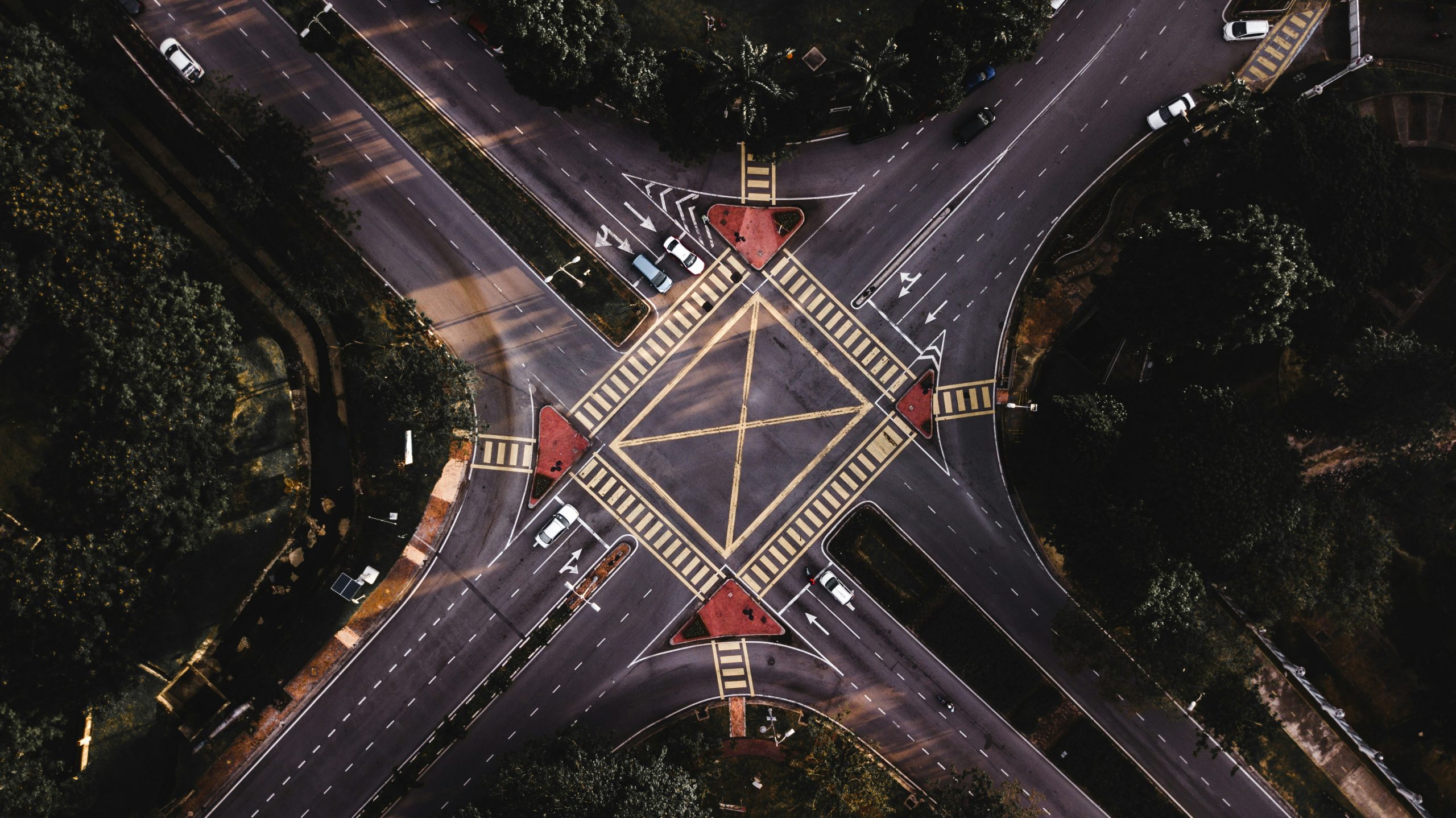
Imagine you are driving in your favorite city. Inevitably, you arrive at an intersection. You encounter a red light and end up waiting behind another car. When the light finally turns green, the car before you initially does nothing before slowly accelerating. Only then are you able to accelerate as well and cross the intersection at a moderate speed. Could this experience be different, if you and the person before you were inside autonomous vehicles?
With several prototypes for autonomous vehicles hitting the market, it will not be long before we encounter autonomous vehicles in our day-to-day lives. Our current traffic management systems, like traffic lights, are designed for human-driven vehicles. This begs the question: can traffic management systems be improved to be more efficient when dealing with autonomous vehicles? It turns out that autonomous vehicles with their advanced technological capabilities can pave the way for newer traffic management strategies, especially at bottlenecks such as road intersections.
Vehicle platooning is one such strategy. It exploits the communication capabilities of (autonomous) vehicles to keep vehicles in a 'linkless train'. Imagine a train with numerous carriages. The carriages are linked to each other and the train locomotive typically pulls the whole train forward along the tracks. Platooning achieves the same idea, but with cars and trucks (for example) instead of carriages. There is no physical link between two consecutive vehicles, but vehicles can communicate with each other wirelessly. By doing so, they are able to synchronize their movements and move as a unit (also called a platoon) at a high speed.
Research studies have shown that platooning near intersections can provide benefits such as reduced travel times and fuel emissions compared to traditional traffic lights with a static cycle. This is partly because platooning reduces the aerodynamic drag experienced by all vehicles except the leading vehicle (which is the locomotive in our train analogy) in the platoon. Moreover, with platooning in place, vehicles are able to cross the intersection at high speeds, leading to more vehicles being able to cross the intersection in the same span of time. In other words, no more waiting for the person before you to start accelerating! This could even reduce road noise, as there is no need to honk at drivers who are slow to notice (honking like this is illegal, by the way!).
Me and my colleagues researched a platooning-based system to manage traffic around intersections, by using a combination of two algorithms: a 'platoon-forming algorithm' and a 'speed-profiling algorithm'.
The platoon-forming algorithm organizes previously 'scattered' vehicles into platoons and generates a customized 'green' time for each vehicle; this is the time when it can safely enter the intersection area. This green time is generated well before the vehicle reaches the intersection, based on information about other vehicles arriving at the intersection.
Since we would like vehicles to cross the intersection at a high speed, they should not stop and wait just before the intersection area. This is where the speed-profiling algorithm comes in. It produces an optimal path for each vehicle. Simply put, so they approach the intersection at the correct 'green time' while maintaining a high speed.
A common assumption made when developing new frameworks for autonomous vehicles is that all traffic has identical characteristics. For example, that all vehicles in the world are cars of the same make and model. We call this traffic homogeneity. This simplifies the problem at hand, and can even lead to elegant solutions; however, this approach drives the problem further away from reality. With our work, we make away with the traffic homogeneity assumption and show that the resulting framework is not complex to analyze.
In fact, for some variants of the speed-profiling algorithm we can derive closed form expressions, which are essentially formulas, like the ones taught in high school mathematics classes. Without a closed form expression, obtaining an optimal path typically requires doing loads of calculations. And those calculations are for typically one situation only, not all possible situations! These calculations are part of the extensive field of mathematical optimization. So, closed-form expressions are valuable in many ways: they allow for significantly faster computation, they lead to more precise solutions, and they lead to insights that would be difficult to gain by optimization alone.
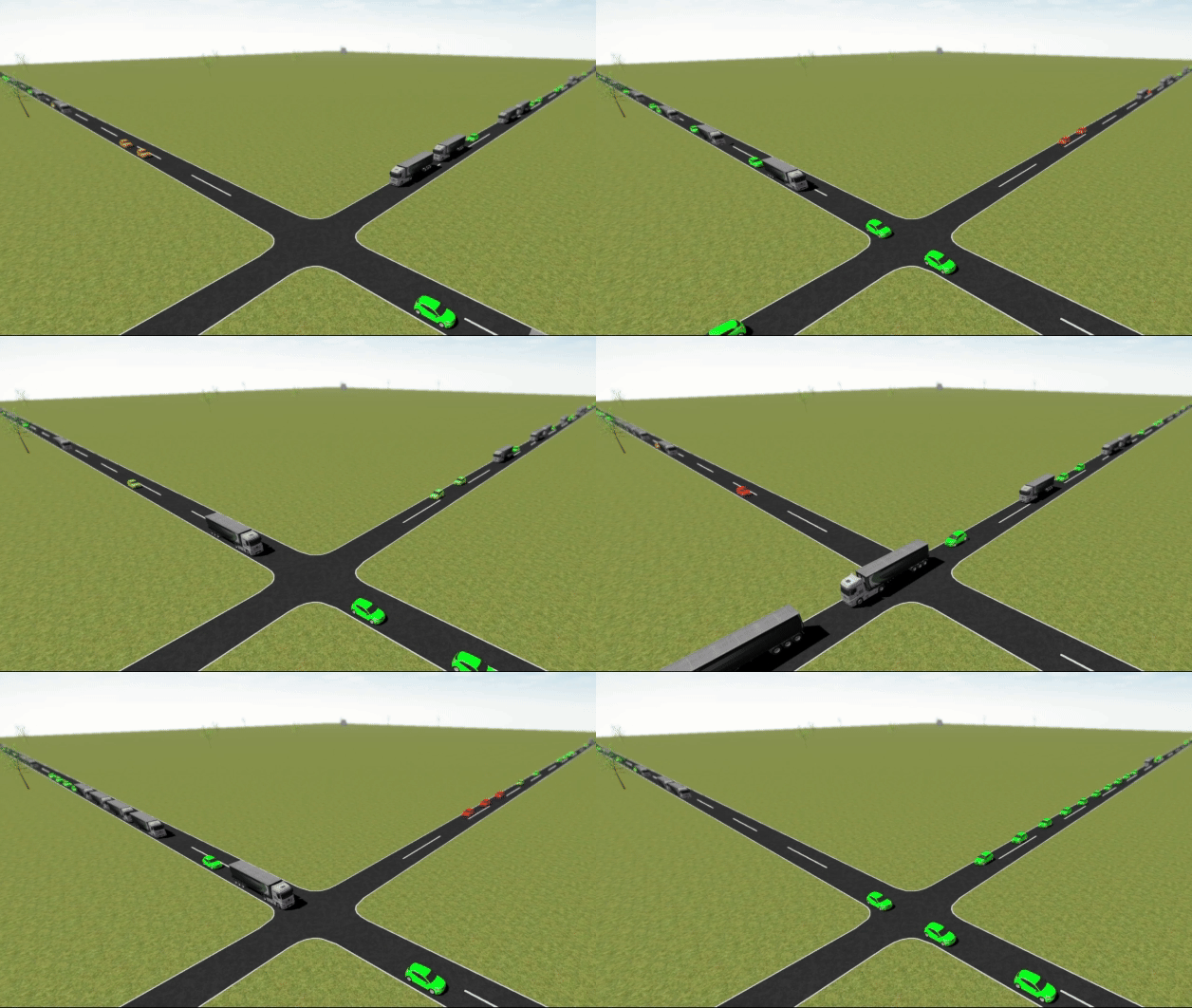
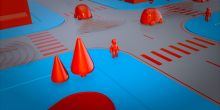
Below is a simulation of an intersection. The cars and trucks form platoons that cross the intersection together. The next time you are at an intersection yourself, waiting for the car in front of you to accelerate, think about what it could possibly be like if vehicles were autonomous and talked to each other!
A 3D simulation of the platooning system that was made for the research project.
Road traffic analysis is one of the topics that receives a lot of focus in the NETWORKS program. Are you courious to read what kind of questions about road traffic mathematicians try to answer? Have a look at this update.
In 2014, in the Netherlands, Belgium and Germany, the average person spend approximately 40 hours in a traffic jam - that is 5 work days! In this article, I will explain how mathematical models with uncertainty help traffic engineers to make decisions that improve traffic.
If, after reading the title, your immediate response is to shout "1/6-th", then you have correctly answered the question. Well done! However, in this article we will focus on the meaning of this question. What exactly is this "chance" of which you've just exclaimed it equals 1/6-th?
During our teenage years, everything changes. It’s no surprise that our brain does too. But how do we make sense of this transformation? Is there a way to quantify it? Networks might just be the answer.