PhaseCAP: Phase Transitions in Combinatorics, Algorithms, Probability
May 18th, 2026
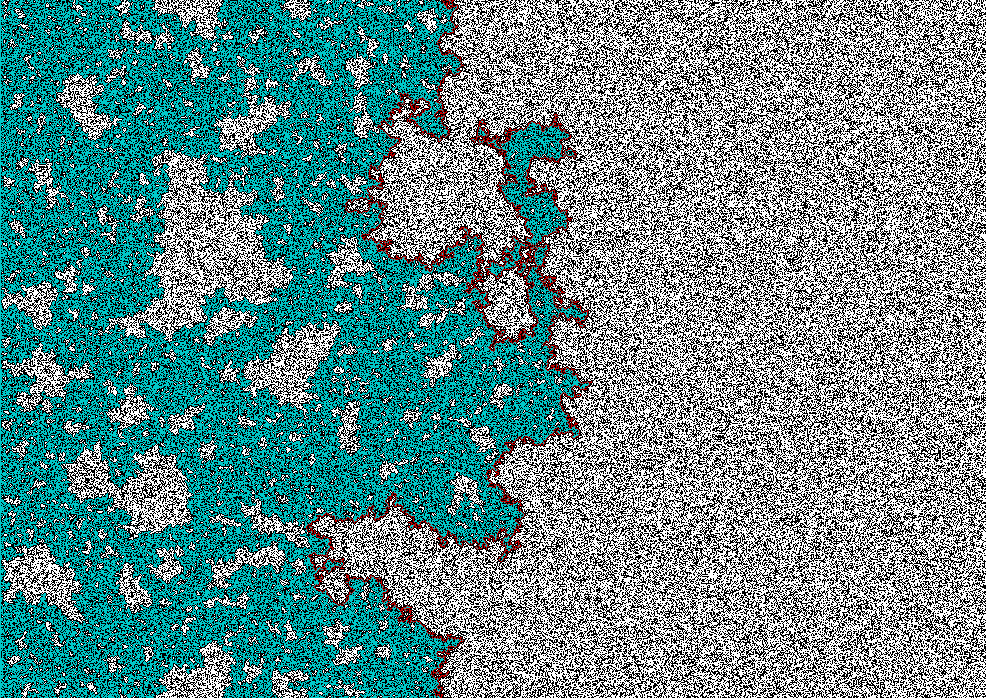
How can we understand the underlying structure of a large-scale network? Which local constraints determine an algorithm’s running time? In recent years, ideas inspired by physics have proved fruitful in tackling such questions. Central to this approach is the notion of a phase transition: a sudden change in macroscopic behaviour. A familiar example is water, which abruptly changes from ice to liquid as the temperature crosses a critical point.
In random network theory, a classic instance of this phenomenon occurs when the structure of connected components changes abruptly once a parameter passes a certain threshold. If you'd like to see this in action, consider reading this article:
Related effects have also been identified in combinatorics and algorithmic theory, even in entirely deterministic settings, for example in counting complexity or extremal combinatorics. Many of these initially surprising behaviors are now being reinterpreted through the lens of phase transitions. This suggests that deeper, unifying principles are at work beneath the surface. Developing a systematic framework to capture these principles would help shed light on the questions raised above.
The PhaseCAP research semester program draws on the theory of phase transitions in statistical physics to shed light on fundamental questions in combinatorics, algorithms, and probability. It is currently taking place: two workshops have been held, while the last one is set to take place from May 26 to May 29, 2026.
PhaseCAP is also a Strategic Research Initiative of 4TU+.AMI. The workshops bring together researchers from the 4TU universities working on combinatorics, algorithms and probability, as well as national and international experts in these fields. . Through focused, problem-driven collaboration, the goal is to generate new insights and advances.
The first workshop took place in the week beginning 30 March 2026 and was centered around Probability. This includes topics such as sharp thresholds in random discrete structures and graph limits.
The second workshop was held in the week beginning 13 April 2026 and was centered around Combinatorics. This includes problems and methods that mix extremal and probabilistic combinatorics.
The third workshop, "Phase A" is scheduled in the week beginning 25 May 2026 and is centered around Algorithms. The topic of the workshop is algorithms for counting coloring, homomorphisms, satisfiable assignments, and phase transitions in these. This includes topics such as graph polynomials, parameterized complexity, approximate counting and randomized algorithms.
The remaining workshop is invitation-only, except for the plenary talks. You can register for these talks on this page.
PhaseCAP is organized by: Ferenc Bencs (CWI), Jop Briët (CWI), Serte Donderwinkel (Groningen University), Carla Groenland (TU Delft), Ross Kang (University of Amsterdam), Noela Müller (TU Eindhoven), Guus Regts (University of Amsterdam).
Percolation theory is a branch of mathematics at the interface between probability theory and graph theory. The term 'percolation' originates from materials science. A representative question is as follows. Suppose some liquid is poured over a porous material. Will the liquid be able to make its way from hole to hole and reach the bottom?
Think of a local car dealer selling cars in your region. To make sure new cars are delivered on time a whole mechanism involving various people, factories, and transport companies, must operate in coordination. This is a highly complex process where mathematics plays an important role.
In 1995, a flood in the town of Itteren led to the evacuation of 250 000 people and a million animals. Consequently, the Dutch regional water authorities were tasked with calculating how often an area overflows, such that better measures could be taken. How do these calculations work?