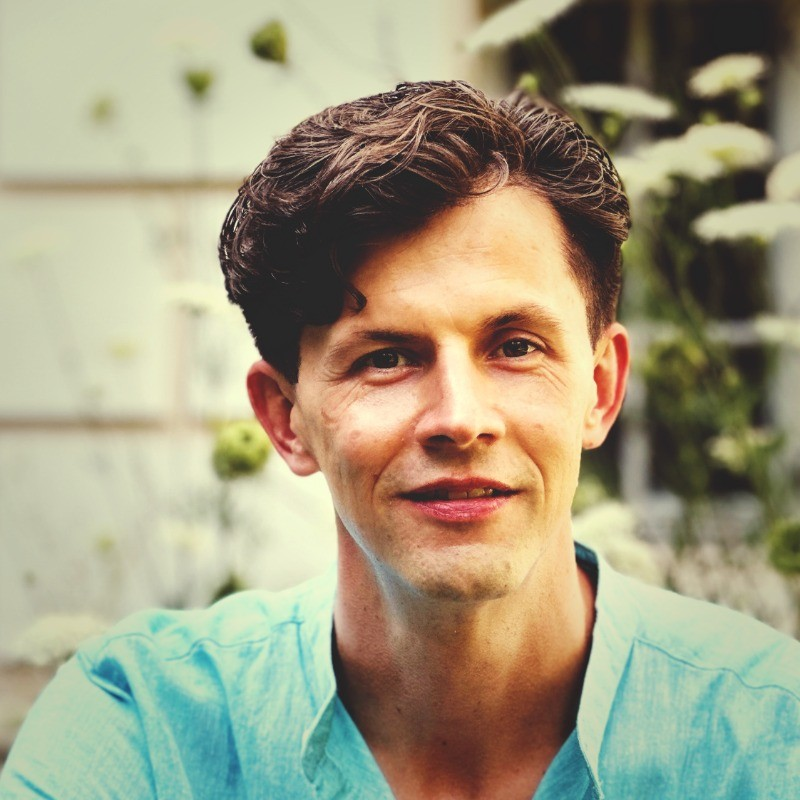
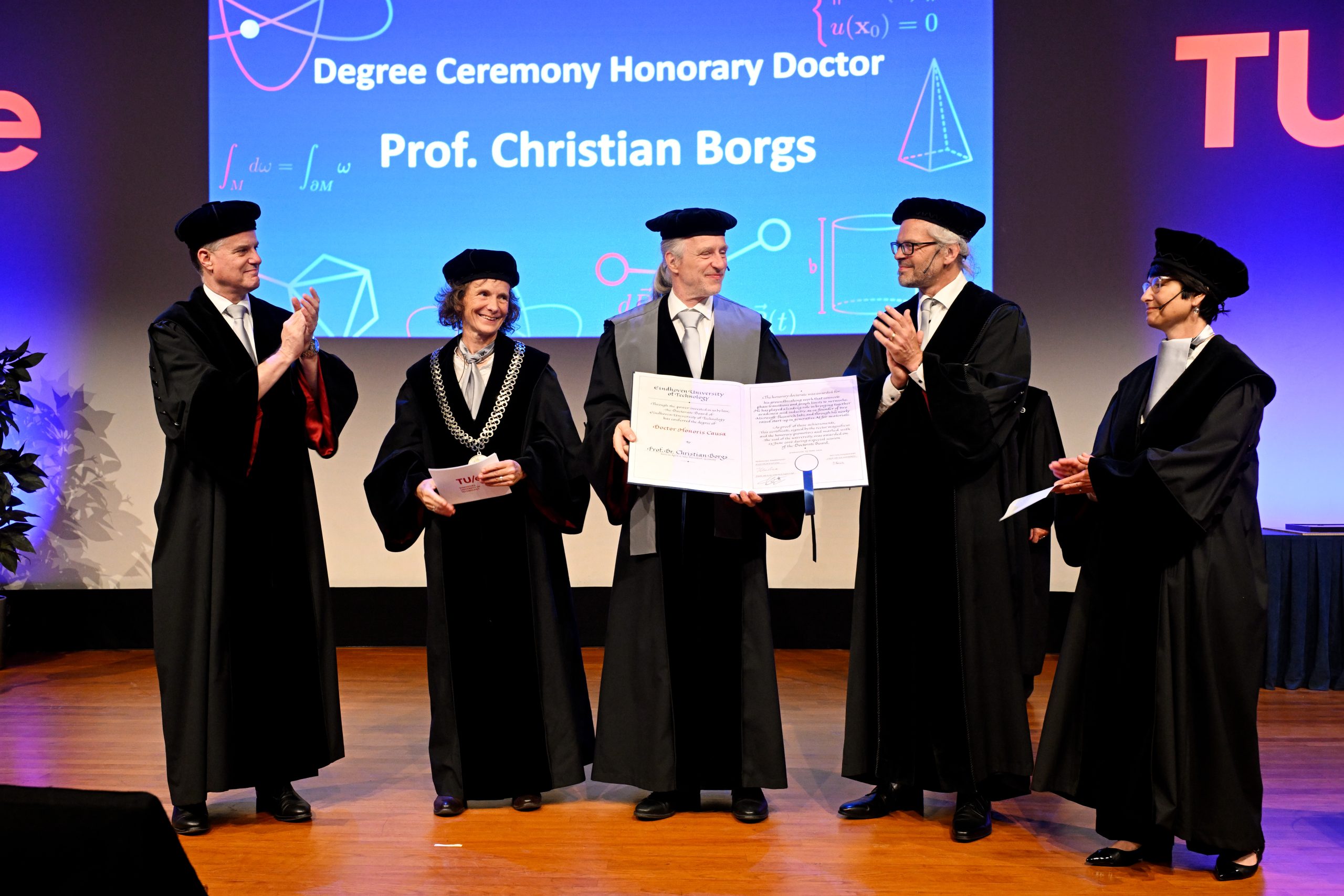
What do quarks in the early universe, the structure of the World Wide Web, and the search for new materials that can capture CO2 have in common? At first glance, not much. But for Christian Borgs, who received an honorary doctorate from Eindhoven University of Technology earlier this year, they are all part of a scientific journey fueled by a desire to better understand the world through mathematics.
For Borgs, the honorary doctorate was a "wonderful event." It lasted several days and included a variety of activities like a conference, a panel discussion, a formal ceremony, a dinner and a visit to the Institute for Complex Molecular Systems. In general, the event celebrated and recognized Borgs' contributions to science. At the conference, he gave a short talk on networks, showing how they provide a common mathematical language for seemingly different problems, such as pandemics and privacy. During the panel discussion, he reflected on his own experiences and shared advice with the next generation of scientists. And the highlight of the program was the formal ceremony, during which he received the honorary doctorate from Eindhoven University of Technology. But the journey towards such recognition begins long before the ceremony. For Borgs it is the result of a lifelong interest in science driven by curiosity.
How it all began
Borgs' interest in mathematics developed early. His mother, who was good at both art and mathematics, was an important role model for him. In fact, whenever he ran into people he had gone to primary school with, they would always ask him: "So Christian, did you become an artist or a mathematician?"
However, in high school, his interests took a different direction. After reading a book by Heisenberg, he remembers thinking: “Oh, physics sounds so much more interesting.” And so Borgs started his studies in physics. He enjoyed the experiments, but something was missing for him. The lectures would often derive results, but to him, it felt as though they were cheating: the arguments lacked the rigor he was looking for.
During his thesis research, however, Borgs was able to work on an interesting physics problem that was formulated in purely mathematical terms. This combination of rigor and real-world applications fascinated him and would later prove to be a recurring theme in his work. His thesis also shaped his view of how mathematicians should collaborate with scientists from other disciplines. Rather than simply using mathematics to demonstrate that an argument from physics or biology is incorrect, he believes that mathematicians should first try to understand what their colleagues are trying to express. Borgs emphasizes that he enjoys it most when his mathematics gives others a deeper conceptual understanding of their work.
“We have to try to understand what they really want to say, translate it into a mathematical problem, and then try to actually do the mathematics on that problem.”
First academic works in physics
Already his first published results are examples of how Borgs brings rigor to problems in physics. His first paper, Quark Deconfinement at High Temperature, investigated a difficult problem in Lattice gauge theory. This theory provides a way to represent the elementary particles of the universe onto a lattice, a network of points approximating space-time, allowing researchers to study the behavior of such particles mathematically. Borgs was trying to understand how quarks, the building blocks of our world, could become separated at extremely high temperatures in the early universe. While under normal conditions, quarks cannot be pulled apart, a property called confinement. He wrote this paper while visiting the research institute IHES in Paris, which is an experience he remembers fondly. But he also remembers thinking: "Will I ever do something as good again?"
His work in physics did not stop there. During his postdoc in Zürich, Borgs collaborated with Roman Kotecki. Together they developed a mathematically rigorous theory of Finite Size Scaling. Their work provided a tool for other researchers that answers questions about how systems behave as their size increases. This is important because many physical systems are too large to simulate as a whole. For example, the world around us consists of atoms, which is far more than any computer simulation can handle. Finite-size scaling helps researchers use smaller systems to draw conclusions about the behavior of much larger ones.
For Borgs, this result was particularly rewarding. By applying their mathematical understanding, they had developed a tool that helped other researchers answer questions that had previously been difficult to tackle. He specifically enjoys doing mathematics when it feels like you are making an impact.
Applications leading to unexpected mathematics
Sometimes, however, the mathematics takes on a life of its own. One of Borgs's favorite examples began at Microsoft, where he and his colleagues were thinking about a very practical problem: how could a search engine distinguish genuinely important web pages from those that just seemed important because they had thousands of artificial links pointing to them?
They suspected that the answer lay in the structure of the Web itself. But how could one describe the structure of a network containing billions of connections? To make the problem mathematically precise, they realized they needed to understand what happens to the structure of a graph as it becomes larger and larger, eventually approaching an infinite network.
Surely mathematicians had already developed a theory for that, right? So Borgs and his colleagues turned to experts in combinatorics, only to discover that no such theory existed. Therefore, they decided to develop one themselves.
What emerged, through work with Jennifer Chayes, László Lovász, Katalin Vesztergombi, and Vera Sós, was the theory of graph limits and graphons. Along the way, the original search-engine problem faded into the background as the mathematical questions became interesting on their own. And, as often happens with new mathematics, the resulting theory eventually found applications that nobody had anticipated, including new ways of analyzing and estimating large networks. Borgs described the process as follows:
"I think it's this nice arc of starting an application, disappearing into Mars land, and [...] this surprising usefulness of mathematics in ways you didn't think of,"
What comes next?
Borgs' journey through mathematics, physics, and computer science has now taken another turn: applying AI to problems in materials science and chemistry. Working with chemists, he is exploring how AI can help discover new materials, for example, materials that capture CO₂ or extract water from dry air. The goal is to develop materials that will hopefully do something good for the world.
In some ways, this brings him back to where he started: working closely with scientists on concrete problems, while bringing mathematical and computational ideas to questions that might otherwise be difficult to tackle. But as his career has shown, one never quite knows where such questions will lead.The honorary doctorate also opens opportunities for closer ties with Eindhoven. Borgs hopes to build on his ongoing collaborations with Nelly Litvak and Remco van der Hofstad. His connection with Remco goes back many years, to the beginning of his time at Microsoft. "Remco was one of our first visitors when I started at Microsoft many years ago," Borgs recalls. "We had these hour-long discussions, constantly interrupting each other. We've kept working together ever since. Perhaps visiting Eindhoven will give us a chance to interrupt each other again."
Think of a local car dealer selling cars in your region. To make sure new cars are delivered on time a whole mechanism involving various people, factories, and transport companies, must operate in coordination. This is a highly complex process where mathematics plays an important role.
Rafael Prieto-Curiel is a mathematician and a faculty member at the Complexity Science Hub in Vienna, Austria. His research focuses on crime, mobility, migration and urban dynamics. We interviewed Rafael to learn about his story.
During our teenage years, everything changes. It’s no surprise that our brain does too. But how do we make sense of this transformation? Is there a way to quantify it? Networks might just be the answer.
In the summer of 2026, workshop center Eurandom is hosting a special mini-symposium, organized on the occasion of Christian Borgs, Professor of Computer Science at UC Berkeley, receiving an honorary doctorate at TU/e
In November 2024, the Kick-Off meeting for BeyondTheEdge: Higher-Order Networks and Dynamics took place at Vrije Universiteit (VU) Amsterdam. The event marked the official start of the project, read an interview with Christian Bick, Principal Investigator and Project Coordinator of BeyondtheEdge.


 atoms, which is far more than any computer simulation can handle. Finite-size scaling helps researchers use smaller systems to draw conclusions about the behavior of much larger ones.